
A Blacked-Out Page Still Needs an Explanation
Updated: 2 days ago
A black bar tells you that information is missing. It does not tell you what the missing words say, why they were withheld, or whether the withholding would survive a challenge. Serious scrutiny starts with the agency's stated legal basis and then follows the FOIA process from there.
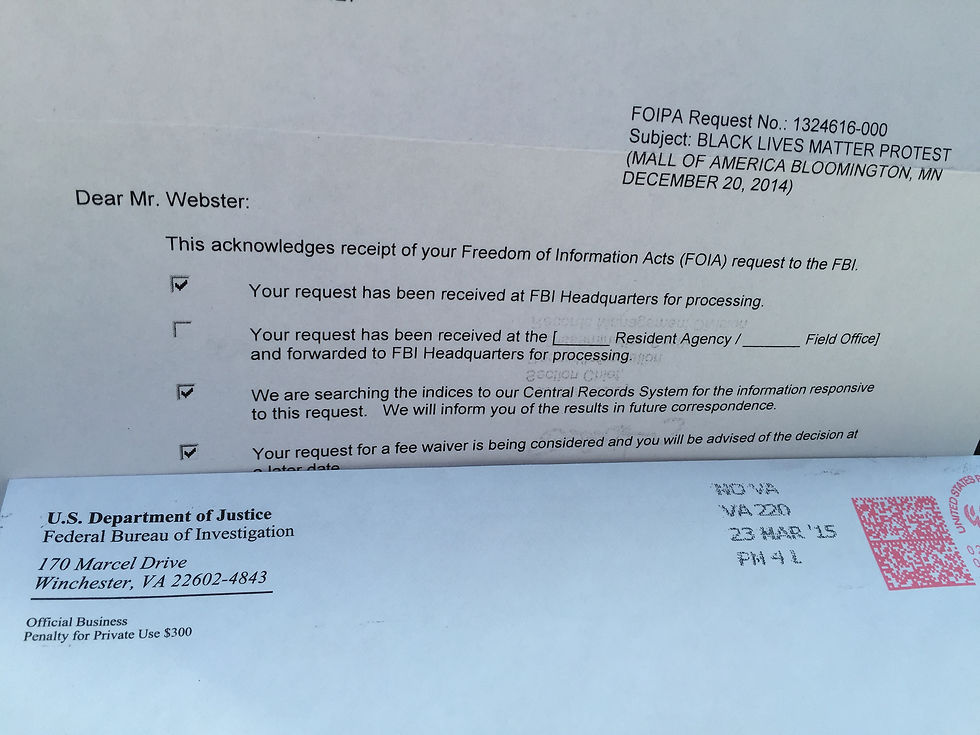
FBI FOIA correspondence photographed on April 2, 2015. An archival example of the request process, not a newly released redacted record. Photo: Tony Webster. Image unmodified. Photo source · CC BY 2.0
Start with the exemption actually cited
Federal FOIA contains nine statutory exemptions. They protect different interests, so “redacted under FOIA” is not a complete explanation.
Exemption 1: properly classified national-defense or foreign-relations information.
Exemption 2: certain internal agency personnel rules and practices.
Exemption 3: information another federal statute prohibits from disclosure.
Exemption 4: trade secrets and confidential or privileged commercial or financial information.
Exemption 5: privileged inter-agency or intra-agency communications, including privileges recognized in civil discovery.
Exemption 6: personnel, medical and similar records where disclosure would invade personal privacy.
Exemption 7: records compiled for law-enforcement purposes, but only to the extent one of the statute's specified harms or protections applies.
Exemption 8: information concerning the supervision or regulation of financial institutions.
Exemption 9: geological and geophysical information and data concerning wells.
The exemption number tells you which legal category the agency is invoking. It does not reveal the hidden text, and it does not by itself prove the agency applied the exemption correctly.
An exemption is not the end of the analysis
FOIA's foreseeable-harm standard generally requires an agency to reasonably foresee that disclosure would harm an interest protected by an exemption, unless disclosure is prohibited by law. DOJ guidance says speculative, abstract or embarrassment-based concerns are not enough.
The details depend on the exemption. Some withholding is constrained by another statute or by the structure of the exemption itself. The useful question is not simply “Can the agency cite an exemption?” but “What legal basis and harm analysis apply to this withholding?”
Ask what could still be released
FOIA also requires reasonably segregable non-exempt portions of a record to be released after exempt material is deleted. DOJ guidance further explains that agencies should mark the location of deletions where technically feasible and identify the exemption being asserted.
That makes a heavily redacted page a document to analyze, not a blank canvas for speculation. Keep the released page, the exemption markings and the agency's response letter together.

Separate what is visible from what is inferred
A disciplined reading keeps three layers apart: the material you can inspect, the agency's stated reason for withholding, and the information you still do not know.
A redaction can be challenged. It is not evidence that the concealed text contains the explanation a political argument wants it to contain. The hidden material remains unknown unless another record, disclosure or adjudication establishes it.
The challenge path has several stages
A requester has a statutory right to administratively appeal an adverse FOIA determination. DOJ guidance notes that adverse determinations can include full or partial exemption-based withholding, inability to locate records and certain procedural decisions such as fee-waiver or expedited-processing determinations.
Agency response letters should explain appeal rights and deadlines. Filing an administrative appeal gives the agency another opportunity to review its initial decision and preserves the requester's administrative path.
Where OGIS fits
The Office of Government Information Services at the National Archives is the federal FOIA ombuds office. It provides neutral, non-binding dispute-resolution assistance and can help clarify process, facilitate communication and identify options.
OGIS does not enforce FOIA, compel an agency to release records, replace the administrative appeal process or handle a request that is already in litigation. Its role is assistance and dispute resolution, not adjudication.
Litigation is a different stage
If the administrative process does not resolve the dispute, FOIA permits judicial review in federal district court subject to the statute's requirements. At that point, the dispute is no longer simply a disagreement over a blacked-out page; the legal sufficiency of the agency's search, withholding or other determination can be tested in court.
A better way to describe a redacted release
A useful public summary should identify what was released, which exemption or exemptions were cited, what explanation the agency gave, what portions remain withheld, and whether an appeal, OGIS process or lawsuit has changed the record.
That produces a claim readers can actually check: “The agency withheld this material under this exemption. Here is the stated basis. Here is what remains disputed.”
Black bars are evidence of withholding. They are not evidence of whatever someone imagines is underneath them.
The Receipts
The sources below are the records this article relies on. Open them directly and check what they establish for yourself.
Explore This Topic
Government & Accountability
Public power, institutional oversight, records, and measurable accountability.



Comments