
What a Trade Deficit Actually Measures, and What It Doesn’t
Updated: 13 hours ago

Container ship at the Conley Container Terminal in Boston Harbor, 2024. Photo: Colleen Roche / NOAA Office of Coast Survey. Public domain. Photo source
A trade deficit is not an export scorecard. It is the difference between what the United States exports and what it imports.
That sounds simple, but headlines often treat the balance as though it were a single measure of whether American trade is “winning” or “losing.” The underlying data are more specific than that.
Start With the Equation

The Bureau of Economic Analysis defines exports as goods and services sold by U.S. residents to foreign residents. Imports are goods and services purchased by U.S. residents from foreign residents. The trade balance is exports minus imports.
If exports are larger than imports, the result is a surplus. If imports are larger than exports, the result is a deficit.
Because the balance depends on two moving numbers, the deficit can widen even when exports increase. It can also narrow while exports fall if imports fall even faster.
A Wider Deficit Does Not Mean Exports Fell

Imagine exports rise from $300 billion to $305 billion while imports rise from $390 billion to $410 billion. Exports increased by $5 billion. Imports increased by $20 billion. The deficit still widens because imports grew by more.
All three statements are true at once: exports rose, imports rose and the trade deficit widened.
That is why a headline about the balance should not be translated into a claim about exports unless the export data actually support it.
Goods and Services Can Move Differently
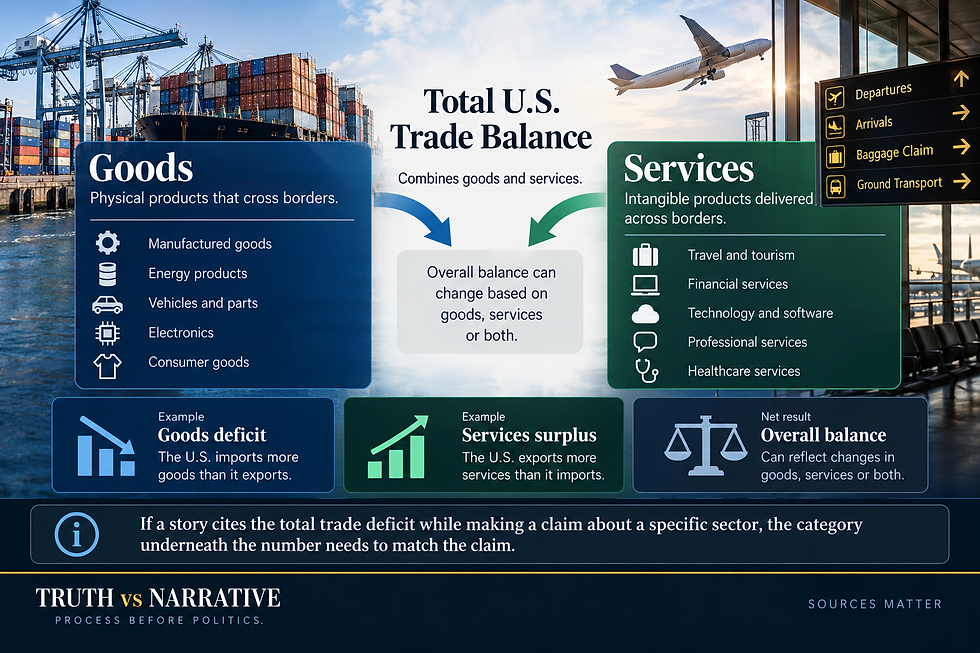
The headline U.S. trade balance combines goods and services. Those two parts do not always move in the same direction.
The United States can run a goods deficit while running a services surplus. A change in the overall balance can therefore reflect changes in goods, services or both.
If a story cites the total trade deficit while making a claim specifically about manufacturing, energy, tourism, financial services or technology, the category underneath the number needs to match the claim.
Nominal Trade Is Not the Same as Real Trade

The standard monthly headline figures are current-dollar values. Price changes can affect those totals.
BEA and Census also publish real, inflation-adjusted goods measures. A nominal increase can therefore reflect a mix of changes in quantities and prices. If the question is how much physical trade volume changed, a current-dollar headline may not be enough.
The Balance Alone Does Not Explain Why It Changed

A trade deficit tells you the arithmetic relationship between exports and imports. By itself, it does not tell you what caused the change.
Imports can move because of consumer demand, business investment, energy prices, inventories, exchange rates, supply chains, tariffs or one-time transactions. Exports can move for equally varied reasons.
A larger deficit therefore does not automatically prove that domestic production weakened, that exports collapsed, that consumers are worse off or that a specific trade policy succeeded or failed. Those claims require additional evidence.
A Bilateral Deficit Is Not the Same as the National Balance

Trade balances are also reported by country. A deficit with one trading partner is not the same thing as the overall U.S. trade balance.
Modern supply chains can move components through several countries before a finished product reaches the United States. Bilateral numbers can be useful, but they should not be treated as a complete map of where economic value was created.
Monthly Trade Data Can Be Revised
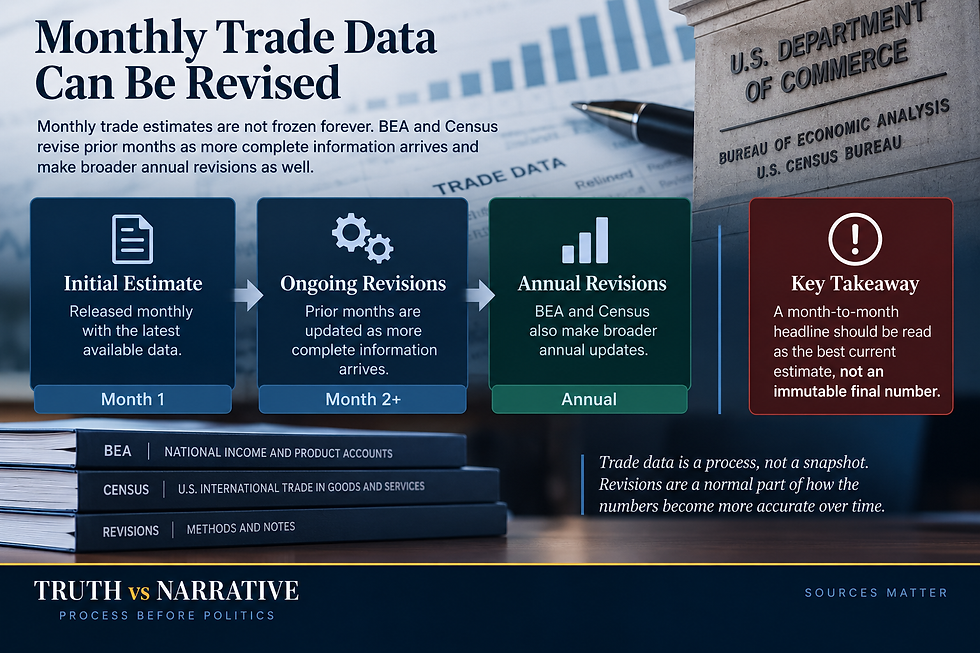
Monthly trade estimates are not frozen forever. BEA and Census revise prior months as more complete information arrives and make broader annual revisions as well.
That means a month-to-month headline should be read as the best current estimate, not an immutable final number.
A Better Way to Read the Headline

Before deciding what a trade number means, ask a few basic questions:
Did exports rise or fall?
Did imports rise or fall?
Is the story about goods, services or the combined balance?
Are the figures nominal or inflation-adjusted?
Is the comparison month-to-month, year-to-date or year-over-year?
Were prior months revised?
Does the claim explain the cause, or only describe the arithmetic?
The Number Is Real. The Story Still Needs Work.

A trade deficit is a useful economic measure. It becomes misleading when it is asked to answer a question it was not designed to answer.
Read the exports. Read the imports. Read the category. Then decide what the balance actually establishes.
For the full TVN framework for reading economic and political numbers, see How to Read Political Statistics: Baselines, Denominators, Rates and Timeframes.
For a focused guide to category matching, see Category Discipline: Define It Before You Count It.
Explore the U.S. Trade Balance Data File for primary-source measurements, reporting periods and revision history.
The Receipts
The sources below are the records this article relies on. Open them directly and check what they establish for yourself.
Official definition / primary reference
BEA — International Trade in Goods and Services
Open the record ↗ (opens in a new tab)Official glossary / primary reference
BEA — Balance on Goods and Services
Open the record ↗ (opens in a new tab)Official definitions / primary reference
U.S. Census Bureau — Common Trade Definitions
Open the record ↗ (opens in a new tab)EXPLORE THIS TOPIC

Economy
Economic data, affordability, trade, and the gap between headlines and household reality.
Explore Economy →



Comments